

Rustam Tghizadeh & Mohammad Ali Ghanamizadeh Fallahi
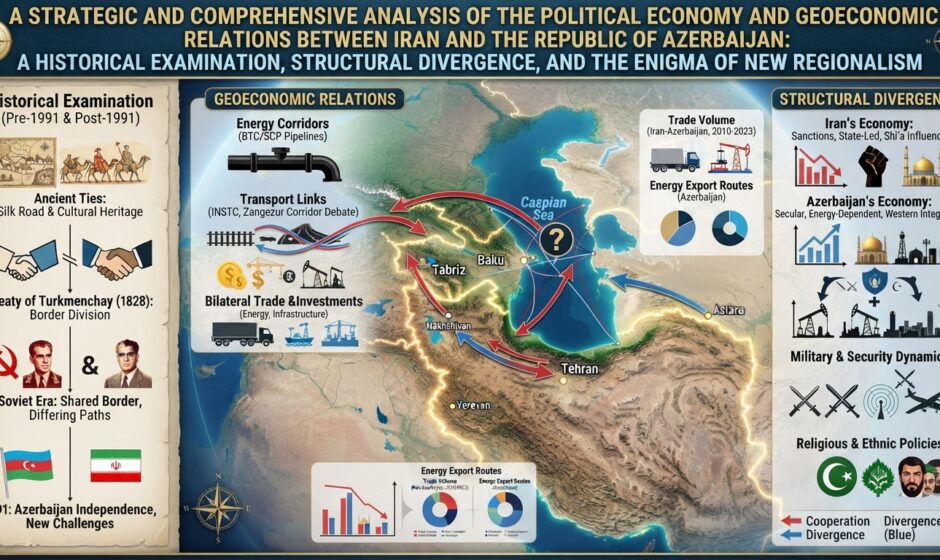
The South Caucasus, as one of the most vital yet fragile geopolitical and geoeconomic centers of Eurasia, has perpetually served as an arena for the converging interests of regional and extra-regional powers. Within this complex geography, the relationship between the Islamic Republic of Iran and the Republic of Azerbaijan, two strategic neighbors sharing extensive land borders (approximately 618 kilometers) and common maritime boundaries in the Caspian Sea, is of fundamental importance. Despite benefiting from profound historical, cultural, and religious roots, including possessing the highest proportion of Shia populations in the world after one another, these two actors have pursued entirely divergent trajectories in the realms of political economy and strategic orientation. To precisely understand the nature of this relationship, it is necessary to transcend reductionist political analyses and engage with the conceptual frameworks of “structural political economy,” “new regionalism,” and “geoeconomic resilience.”
The political economies of these two nations are founded upon antithetical bases. By adopting a resource-based economic model reliant on substantial hydrocarbon revenues, the Republic of Azerbaijan has constructed a centralized political economy structure. In this structure, the state management of energy resources not only plays a pivotal role in maintaining institutional stability and advancing macro-level strategies but has also enabled the country to develop its sovereign capacities and geoeconomic influence at the regional level. Conversely, Iran’s political economy in recent decades has been dan affected by systematic multilateral and unilateral Western sanctions, compelling it, for the sake of survival, to adopt the doctrine of a “resistance economy” and to develop north-south and east-west transit networks. These substantive differences in the architecture of political economy, coupled with the increasing influence of extra-regional actors such as the United States, the Israeli regime, and Turkey, have caused the bilateral relationship to move not toward institutionalized convergence but along a path of divergence and geoeconomic collision.
The Evolutionary Trajectory of Political Economy and Geoeconomic Relations Across Historical Periods
The Transition Era, Independence, and Ideological-Security Frictions (1991 to 2000)
The collapse of the Soviet Union in 1991 and the emergence of the Republic of Azerbaijan as an independent political entity marked a watershed moment in the geopolitics of the Caucasus. Iran was among the first nations to recognize the independence of its northern neighbor, establishing formal diplomatic relations in 1992. Nevertheless, the heavy shadow of history was evident over this relationship from the very beginning. The 1828 Treaty of Turkmenchay, which resulted in the secession of territories north of the Aras River from Iran and their annexation to the Russian Empire, bequeathed a geopolitical and identity-based issue labeled Divided Azerbaijan (Brown, 2004:580). This has persistently functioned as a latent yet potent variable in the perceptions of both countries’ elites, overshadowing their bilateral relations in every dimension. In the 1990s, the political economies of both states were in a state of crisis. Iran had recently emerged from an eight-year war with Iraq and required the reconstruction of its economic infrastructure. Simultaneously, the Republic of Azerbaijan was embroiled in the First Nagorno-Karabakh War (1988-1994), which resulted in a military defeat for Baku, the occupation of vast portions of its territory, and the severance of its direct territorial and economic link to the exclave of Nakhchivan (Gasimova, 2022:2-3). The severing of these vital arteries drastically weakened the geoeconomic position of the Republic of Azerbaijan, making it dependent on Iranian territory for access to Nakhchivan.
Geoeconomic Pragmatism, Corridor Politics, and Managed Securitization (2000–2026)
Between 2000 and 2025, Iran–Azerbaijan relations evolved from cautious pragmatism to securitized geoeconomics. Trade, energy swaps, and North–South connectivity enabled cooperation, yet Baku’s westward energy partnerships and post-2020 corridor ambitions, especially Zangezur, sharpened Tehran’s threat perceptions. Thus, economic engagement remained selective, corridor-centered, and politically managed, shaped by sanctions, Iran’s institutional security concerns, Azerbaijan’s EU-facing energy role, and the wider South Caucasus competition among Russia, Turkey, and Western actors rather than by deep regional economic integration (Osuli Odlu et al., 2026:88-100).
Under Pezeshkian, Iran Azerbaijan relations entered a pragmatic phase shaped by economic diplomacy rather than strategic reconciliation. Tehran sought controlled easing, transport talks, and trade openings, while preserving its security red lines amid Turkish energy activism and Iran’s wider revisionist worldview (Akbarzadeh & Naeni, 2025:2315). Thus, the turn was functional: it reopened communication with Baku but did not erase mistrust over Israel, corridors, border security, and sanctions pressure after 2024 in practice or strategy. Turkey’s growing energy hub strategy also shaped Iran’s reading of the Azerbaijan file. Shokri argues that Ankara seeks to use geography, infrastructure, and diplomacy to move beyond passive transit and become an autonomous regional energy actor (Shokri, 2025:1). For Tehran, this intensified concern that Azerbaijan could become part of a wider Turkish centered geoeconomic sphere.
Overall, this pragmatic phase should be read as limited normalization rather than strategic transformation. Economic diplomacy created space for transit, energy, and border management, but the deeper structure of mistrust remained intact. The Pezeshkian administration softened the tone, yet it could not redesign the regional order surrounding Azerbaijan and Iran.
The Zangezur and Aras Corridor in Iran Azerbaijan Political Economy
The Zangezur Corridor
The Zangezur Corridor is not only a transport project. It is a contested geoeconomic idea at the center of the new balance of power in the South Caucasus. In its narrow meaning, it refers to a proposed road and railway connection between mainland Azerbaijan and the Nakhchivan Autonomous Republic through Armenia’s Syunik province, with possible onward access to Türkiye. For Azerbaijan, this route would reduce geographic separation, strengthen East West trade, and deepen the economic links of the Turkic world. The Zangezur corridor as a land and railway connection will create an important geo-economic system for the central Asia region (Çetinkaya & Demirel, 2024:3). However, the project becomes politically sensitive because Armenia rejects any arrangement that weakens its sovereignty over Syunik, while Iran views any change near its northern border as a direct strategic risk.
The main importance of the corridor lies in the relationship between infrastructure, sovereignty, and regional power. Transport corridors in the post-Soviet space are not neutral economic routes. They are also instruments of political influence, market access, and strategic positioning (Zotova & Poltorak, 2024:173). In this sense, Zangezur is part of a broader struggle over who will control connectivity between the Caspian Sea, the Black Sea, Türkiye, Europe, and Central Asia. After the 2020 Karabakh war, Azerbaijan gained a stronger bargaining position, while Armenia became more vulnerable and dependent on external guarantees. Ter Matevosyan argues that the South Caucasus cannot become a stable regional space while borders remain closed, conflicts unresolved, and economic cooperation weak (Ter Matevosyan, 2024:677). This explains why Zangezur is not simply about trade. It is also about the political future of Armenia’s regional integration and Azerbaijan’s postwar leverage.
For Iran, the corridor creates a clear geoeconomic dilemma. Tehran does not oppose regional connectivity in principle, but it opposes any version of the project that could reduce the strategic value of the Iran Armenia border or create an uninterrupted Azerbaijan Türkiye axis under conditions unfavorable to Iran. The corridor could weaken Iran’s role as a transit bridge between Azerbaijan and Nakhchivan and reduce Tehran’s influence in South Caucasus logistics. It could also strengthen the presence of Türkiye and indirectly Western aligned transport networks near Iran’s border. after the Second Karabakh War and Russia’s war in Ukraine, competition among Türkiye, Azerbaijan, Iran, Russia, and the European Union over the future regional order has intensified (Meister, 2024:191-192). Therefore, Iran reads the corridor through both economic and security lenses.
The corridor also has practical limits. The Middle Corridor and Caspian based transport routes have gained importance because Eurasian trade is seeking alternatives to Russian routes, but these networks still suffer from infrastructure gaps, customs problems, limited port capacity, and regulatory fragmentation (Beifert & Moldabekova, 2024:233-235). Thus, Zangezur could improve regional connectivity only if it is embedded in a legally clear and commercially reliable framework. Without Armenian sovereignty guarantees, Iranian security reassurance, and stable customs rules, it may deepen regional mistrust rather than create integration. In political economy terms, the corridor is best understood as a selective connectivity project. It can produce trade gains, but its real meaning depends on who controls the route, who benefits from transit rents, and whether connectivity serves regional integration or geopolitical exclusion.
The Aras Corridor
The Aras Corridor should be understood as Iran’s geoeconomic answer to the Zangezur Corridor debate. While Zangezur would connect mainland Azerbaijan to Nakhchivan through southern Armenia, the Aras route would pass through Iranian territory along the Aras River and keep Iran inside the regional transit map. Its political meaning is therefore larger than transportation. It protects Iran’s access to Armenia, preserves Tehran’s bargaining position in the South Caucasus, and offers Baku a practical alternative when the Armenian route remains politically blocked. The importance of this issue is clear because the Zangezur project has been opposed by both Armenia and Iran, mainly because it may reduce Armenian sovereignty and weaken Iran’s leverage over regional transport routes.
For Azerbaijan, the Aras Corridor has a pragmatic function. It gives Baku access to Nakhchivan without waiting for a final Armenian-Azerbaijani settlement. It also strengthens Azerbaijan’s postwar strategy of using roads, railways, and logistics to consolidate its victory after the Second Karabakh War. that infrastructure and logistics have become central to Azerbaijan’s postwar method of conflict management, because roads and transport projects physically and symbolically reconnect contested spaces to the Azerbaijani state (Mac Glandières, 2025:1095). In this sense, the Aras Corridor is not against Azerbaijan’s regional strategy. It is a useful second option that allows Baku to keep pressure on Armenia while developing a route through Iran.
For Iran, the corridor is both defensive and opportunistic. It is defensive because Tehran wants to prevent any geopolitical change that would disconnect Iran from Armenia or create a direct Turkey Azerbaijan line outside Iranian influence. It is opportunistic because the route can increase Iran’s transit value between the Persian Gulf, the Caucasus, Russia, and Europe. Heiran Nia shows that Iran’s transport network and port capacity can support broader access from South and East Asia to Central Asia, the Caucasus, Russia, the Black Sea, and Europe, especially through North South connectivity (Heiran Nia, 2025:95). The Aras Corridor can therefore help Iran link local border infrastructure with wider Eurasian transport competition.
However, the corridor also has limits. It cannot by itself remove sanctions, banking restrictions, low trust between Tehran and Baku, or the security role of Turkey and Israel in Azerbaijan’s foreign policy. The 2026 analysis of the South Caucasus arms race shows that even after the formal end of the Karabakh conflict, Armenia and Azerbaijan remain locked in a militarized environment, while Iran and Russia also differ over the Zangezur question (Dadparvar & Parto, 2026:8). Thus, the Aras Corridor is best seen as managed pragmatism. It can reduce immediate pressure over Zangezur and give Iran and Azerbaijan a shared economic project, but it does not create deep regional integration unless it is supported by stable customs rules, financing mechanisms, and political reassurance
Dissecting Divergence and the Reasons for the Failure to Establish New Regionalism
The concept of new regionalism in international political economy extends far beyond the signing of classical intergovernmental and security agreements. This approach necessitates the deep integration of financial markets, the convergence of industrial supply chains, the facilitation of the free flow of capital and labor, and most importantly, the intertwining of the interests of the private sector and civil institutions of the countries within a region. The question arises as to why, despite geographical proximity and potential trade capacities, such a sustainable convergence has not materialized between Iran and the Republic of Azerbaijan, and in the South Caucasus more broadly.
Table 1. Structural Obstacles to New Regionalism between Iran and the Republic of Azerbaijan
| Structural Obstacle | Core Logic | Impact on New Regionalism |
| Political economic asymmetry | Azerbaijan’s rentier energy economy is linked to European markets, while Iran’s sanctioned economy is shaped by controls and state institutions. | Trade remains limited to primary goods, not joint value chain investment. |
| Security dilemma | Azerbaijan prioritizes ties with Washington, Tel Aviv, and Ankara, while Tehran reads this as a security threat. | Economic borders become securitized rather than integrated. |
| Sanctions and global pressure | U.S. sanctions, banking restrictions, SWIFT limitations, and secondary sanctions raise the cost of engaging Iran. | Major investment contracts and joint economic projects remain blocked. |
Game‑Theoretic Analysis of Iran–Azerbaijan Geoeconomic Stalemate
The persistent inability of Iran and Azerbaijan to achieve deep economic integration, despite geographical proximity and complementary transit interests, can be systematically explained through game theory. The relationship is best understood as a repeated game with incomplete information, where each side’s strategic choices are shaped by expectations of future interactions and by the perceived intentions of the other player.
- The Repeated Game and the Shadow of the Future
In a one‑shot interaction, defection (pursuing narrow national advantage) is often the dominant strategy. However, Iran and Azerbaijan have been interacting since 1991 and expect to continue doing so indefinitely. This turns their relationship into an infinitely repeated game. Theoretically, such a setting should foster cooperation, because both sides can punish defection in future rounds. Why, then, does cooperation remain limited?
The answer lies in the discount factor – how much each side values future gains relative to immediate security benefits. Both Tehran and Baku heavily discount the future because their domestic political systems, regional alliances, and external pressures (sanctions, military budgets, foreign patrons) create short‑term horizons. When the discount factor is low, even a repeated game can fail to sustain cooperative outcomes.
- Costly Signals and the Credibility of Intentions
Much of the tension between the two countries revolves around signalling. Azerbaijan signals its strategic autonomy by deepening ties with Israel and Turkey – a costly signal because it provokes Iranian retaliation (e.g., border restrictions, diplomatic protests). Conversely, Iran signals its red lines on Zangezur by investing in the Aras corridor and by conducting military exercises near the Azerbaijani border. These actions are costly (financial, diplomatic, or operational), which makes them credible. Cheap talk – diplomatic statements of friendship – carries no such credibility and is therefore ignored.
The Zangezur‑Aras contest is a classic signalling game. Baku insists that Zangezur is a purely commercial project; Tehran interprets it as a geostrategic encirclement tool. Because the true intent of each side is private information (known only to itself), each uses costly signals to reveal its type. Azerbaijan’s refusal to accept sovereignty guarantees for Armenia’s Syunik province signals that its corridor ambition includes a political dimension. Iran’s rapid completion of the Aghband‑Kalaleh bridge signals that it has a ready alternative and will not accept exclusion.
- The Payoff Matrix and the Failure to Reach a Cooperative Equilibrium
The relationship can be modelled as a 2×2 game where each player chooses between “cooperate” (invest in joint connectivity, resolve corridor disputes peacefully, limit anti‑Iranian alliances) and “defect” (pursue unilateral projects, strengthen hostile alliances, block transit).
| Azerbaijan Cooperate | Azerbaijan Defect | |
| Iran Cooperate | Moderate gains for both (joint infrastructure, stable transit) | Iran loses, Azerbaijan gains (Iran’s transit role declines) |
| Iran Defect | Iran gains (leverage over Zangezur), Azerbaijan loses | Low gains for both (frozen conflict, missed opportunities) |
The current equilibrium is mutual defection – the bottom‑right cell. Both sides prefer the top‑left (cooperation) over the bottom‑right, but they cannot trust each other enough to move there. The security dilemma, amplified by third actors (Israel, Turkey, Russia), creates a prisoner’s dilemma structure where defection is individually rational even though cooperation would be collectively beneficial.
- The 2026 War as an Exogenous Shock
The Hormuz blockade and the US‑Israeli campaign against Iran acted as an exogenous shock that temporarily altered the payoff matrix. Iran’s need for northern corridors made cooperation with Azerbaijan more valuable than before, while Azerbaijan’s interest in stable transit revenues increased. This shock lowered the cost of cooperation and raised the cost of defection for both sides, opening a window for pragmatic engagement on the Aras corridor and INSTC. Whether this window will close once the shock passes depends on whether the two sides can use it to build institutions that extend the shadow of the future.
- Policy Implications for the HRIC
The proposed Hybrid Regional Integration Compact (HRIC) can be understood as a mechanism to change the payoff matrix. By creating joint monitoring, revenue sharing, and penalty mechanisms, it would increase the cost of defection and make cooperation verifiable. Over time, this could raise the discount factor, transforming the repeated game from a prisoner’s dilemma into an assurance game where mutual cooperation becomes a stable equilibrium. This is the strategic logic behind linking the Zangezur and Aras corridors as twin wings of a single network.
The Look to the East Doctrine and Resilience through the INSTC
Facing blocked Western convergence pathways and mounting pressure over the Zangezur Corridor, Iran shifted geoeconomic resilience toward the INSTC. Founded by India, Iran, and Russia in 2000, the 7,200-kilometer route became crucial after the 2022 Ukraine war and sanctions, significantly halving Mumbai–Moscow transit time through Azerbaijan (Azmi et al., 2024:8). The corridor’s logic is to turn Iran’s geography into an indispensable hub: Russia gains southern access, while India reaches Central Asian and Caucasian markets (Karadağ Albayrak & Çelik, 2021:225). Its main constraint is Rasht–Astara, now advanced through Russian-backed agreements, 2025 trilateral inspections, and planned 2026 construction, benefiting Azerbaijan through transit revenues.
Overall, the Look to the East doctrine reframes the INSTC as more than a transport scheme; it is a strategic mechanism for economic resilience. By linking Iran to Russia, India, Azerbaijan, and wider Eurasian markets, the corridor reduces exposure to Western sanctions, monetizes Iran’s geography, and creates alternative channels for trade, transit revenue, and diplomatic leverage within an increasingly multipolar regional order beyond the constraints of conventional regional dependence patterns.
The Aras Corridor: A Complementary Infrastructure Layer
Parallel to the INSTC, Iran and Azerbaijan have advanced the Aras Corridor as a practical mechanism for corridor-based regionalism. This road and rail network connects mainland Azerbaijan to Nakhchivan through Iranian territory and rests on infrastructure such as the Jolfa to Kalaleh road and the Aghband to Kalaleh bridge (Israyelyan, 2025:150). Its significance lies in the fact that it gives Baku a shorter and workable route to Nakhchivan while keeping Iran inside the regional transit architecture. In this sense, the Aras route partially answers the connectivity logic behind TRIPP and the Zangezur Corridor, but avoids the exclusionary effect of projects that would bypass Iran and weaken its geoeconomic position (Smolnik et al., 2025:1029).
This pattern shows that Iran Azerbaijan cooperation is moving from symbolic diplomacy toward functional economic interdependence. Bilateral trade reached about 644 to 650 million dollars in 2025, and freight flows through both countries remained substantial, with Iranian and Azerbaijani truck movements increasingly tied to the wider INSTC framework (Bastanifar et al., 2024:11). Even border disruptions and wartime pressures did not break this cooperation, because all parties had incentives to restore corridor functionality quickly. The INSTC and Aras Corridor therefore reveal a pragmatic form of new regionalism: institutionally light, corridor centered, and driven less by political trust than by shared transit revenue, logistical necessity, and resilience under systemic pressure.
The War of 2026 as a Geoeconomic Wake-Up Call: Iran Forced Rediscovery of the Northern Corridors and the Strategic Turn Toward the South Caucasus and Central Asia
The 2026 US–Israeli military campaign against Iran, and the subsequent maritime blockade of the Strait of Hormuz, constituted far more than a military confrontation. They served as a systemic shock to the Islamic Republic’s economic architecture, exposing the profound vulnerabilities embedded in a foreign economic policy that had for decades treated geography as an entitlement rather than an asset to be cultivated. the 2026 war, and specifically the closure of the Strait of Hormuz as a global chokepoint, delivered a transformative strategic shock to Iranian economic statecraft, forcing the long-overdue recognition that maritime dependency on a single chokepoint was untenable in an era of systemic confrontation with the West.
The blockade precipitated a rapid and structural reorientation toward Iran’s northern land corridors, and with them, toward a region, Central Asia and the South Caucasus, that had for decades occupied a marginal, almost forgotten position in Iranian foreign economic policy. Central to this reorientation has been the redefinition of relations with the Republic of Azerbaijan, a neighbour long treated with geopolitical suspicion but now emerging as the indispensable transit partner for Iran’s geoeconomic resilience. Drawing on theoretical frameworks of geoeconomic resilience, supply chain diversification, and new regionalism.
But beyond the global macroeconomic shock, the blockade of Hormuz carried a more specific and existential message for Iranian policymakers. It demonstrated, with brutal clarity, that Iran’s entire external trade architecture was anchored to a single maritime chokepoint, one that could be denied to it at will by superior naval power. attacking Iran means attacking the world’s supply chain; but for Iran itself, the blockade meant the potential strangulation of its economic lifeline.
The Anatomy of Neglect: Iran’s Historical Disengagement from the Northern Corridors
For decades after the Soviet collapse, Tehran treated geography as an automatic source of transit power. Iranian planners assumed that Central Asian and Caucasian trade would naturally move south through Iran because the country offered the shortest land bridge to the Persian Gulf and the Indian Ocean. This logic underestimated the institutional realities of modern logistics. Exporters do not choose routes only by distance; they also consider sanctions exposure, insurance costs, customs reliability, banking channels, regulatory stability, and infrastructure quality.
The consequence was a clear case of strategic underperformance. When the 2022 Ukraine war disrupted the Northern Corridor through Russia, Iran could have presented itself as a natural alternative for Central Asian, Caucasian, and Russian trade. Yet years of limited investment in rail connectivity, border terminals, customs modernization, and predictable transit rules reduced its capacity to capture this opportunity. The deeper reason was Iran’s long-standing southern orientation: oil terminals, commercial networks, bureaucratic expertise, and export logistics were concentrated around the Persian Gulf and the Strait of Hormuz. As a result, northern corridors remained secondary until sanctions, war, and regional competition revealed their strategic importance.
Central Asia and the Caucasus: The Forgotten Land in Iranian Foreign Policy
Within this wider neglect, Central Asia and the South Caucasus remained peripheral in Iran’s foreign economic policy. Although Iran possessed cultural and historical links with Tajikistan and the Republic of Azerbaijan, its engagement with these regions was limited, irregular, and often subordinated to security concerns (Yousif Freij, 1996:75). Sanctions further weakened Iran’s role by making its regulatory and banking environment incompatible with international compliance standards, thereby excluding it from major infrastructure investment flows across the Caspian and Caucasian corridors (M, 2023:110). At the same time, Iran failed to complete critical northern infrastructure, especially the Rasht to Astara railway, despite its centrality to the INSTC.
Iran’s relations with Azerbaijan also suffered from a dominance of geopolitical suspicion over economic rationality. Tehran viewed Baku’s ties with Israel, secular orientation, and ethnic resonance among Iranian Azerbaijanis as security risks rather than opportunities for connectivity. The Zangezur Corridor intensified these anxieties because it could bypass Iran and weaken its access to Armenia and Europe. Consequently, when the 2026 war began and the Strait of Hormuz was disrupted, Iran’s northern alternatives were politically fragile and infrastructurally incomplete. UNCTAD data showed that daily ship transits through Hormuz fell from 129 in February 2026 to only 6 by late March, a 95 percent collapse that disrupted oil, aluminium, fertiliser, and container flows across global supply chains (Strait of Hormuz Disruptions: Implications for Global Trade and Development, 2026).
For Iran, the Hormuz disruption was more severe than for any other affected actor because its export system was overwhelmingly tied to Gulf terminals and passage through the Strait. Unlike Gulf Arab states, which could activate land routes across the Arabian Peninsula, or China and India, which had diversified import channels, Iran lacked rapid alternatives. The 2026 blockade overturned Tehran’s assumption that any Hormuz closure would be self-initiated, limited, and reversible. It showed that the chokepoint could be closed against Iran, making land corridors, pipelines, and Caspian terminals essential to national economic security.
The Shock of Necessity: Why the 2026 War Was Tehran Geoeconomic Epiphany
The Hormuz blockade did more than interrupt Iranian trade; it exposed the weakness of a geoeconomic doctrine built on passive geography. Iran’s location between the Caspian and the Persian Gulf had long been treated as a natural source of leverage, yet the crisis showed that geography without infrastructure, institutions, and trusted neighbours produces little resilience. Tehran’s April 2026 turn toward non southern ports, free trade zones, and Caspian facilities such as Neka was therefore an emergency correction, revealing both northern potential and decades of strategic neglect in national policy planning.
Within this reorientation, the INSTC moved from a delayed developmental project to the core of Iran’s resilience strategy. The corridor’s missing Rasht to Astara railway, stalled for more than two decades by financing, sanctions, and ambiguity, suddenly became urgent. By early 2026, land acquisition had advanced, Russian technical work was underway, and Moscow’s €1.6 billion financing signaled implementation. The blockade thus transformed the northern corridor into a strategic safety cushion, linking survival, sanctions relief, and regional economic integration beyond the Gulf centered export model itself.
Rediscovering Azerbaijan as Iran’s Northern Geoeconomic Gate
The Hormuz blockade forced Tehran to reassess Azerbaijan not as a peripheral or troublesome neighbour, but as a structurally indispensable transit state. Before the crisis, Iran Azerbaijan relations were largely filtered through suspicion over Baku’s ties with Israel, the Zangezur Corridor, and the balance of power in the South Caucasus. Economic ties existed, but they remained modest, with bilateral trade around 650 million dollars, far below Azerbaijan’s trade with Turkey and Russia (Abbasov & Souleimanov, 2022:140). The blockade changed this hierarchy of priorities. Since the western branch of the INSTC depends on Azerbaijani territory to connect Iran with Russia and Northern Europe, Baku became central to Iran’s post crisis geoeconomic planning.
This recalibration quickly moved from discourse to infrastructure and institutional cooperation. The 17th Azerbaijan Iran Joint Intergovernmental Commission in February 2026 produced agreements across transport, energy, customs, water, agriculture, investment, and tourism. More importantly, both sides accelerated practical projects such as the Kalaleh Aghband bridge, the Kalaleh Jolfa road, the Kalaleh Siahroud rail link, and the Astara rail terminal. Transport cooperation became the core of the relationship, especially through border management, railway development, and the expansion of North South and East West corridor capacity. Iran’s target of raising western INSTC transit to 15 million tons annually by 2030 shows that Azerbaijan is no longer treated as a secondary neighbour, but as a necessary partner in Iran’s economic resilience strategy (Lasserre & Alexeeva, 2024:46).
The deeper significance is institutional. Iran, Azerbaijan, and Russia have begun building light but functional mechanisms, including joint working groups, customs coordination, freight rate stabilization, and trilateral inspections. This is not deep political trust, but it is practical regionalism. Azerbaijan’s value for Iran now lies in operational connectivity, transit revenue, and the ability to keep northern trade routes functioning under sanctions, war, and maritime disruption.
Geoeconomic Resilience as Strategic Practice: The Reorientation Underway
From Single-Point Dependency to Multimodal Diversification and e Logic of Corridor-Based Economic Regionalism
Geoeconomic resilience explains Iran’s post blockade turn as more than crisis management. The Hormuz closure exposed the danger of relying on a single maritime chokepoint and pushed Tehran to convert geography into operational capacity through Caspian terminals, Rasht to Astara acceleration, Azerbaijani Russian coordination, and the three branch INSTC, whose western, eastern, and trans Caspian routes provide built in flexibility.
From this shock emerged a corridor-based regionalism that differs from classical integration. It is narrow in function, centered on transit, customs, and energy, flexible in institutions, built through working groups, memoranda, and ministerial coordination, and pragmatic in motivation. Azerbaijan seeks transit rents, Russia needs southern access under sanctions, and Iran requires maritime diversification. This model marks a departure from Iran’s older reliance on declaratory regionalism and distant great power partnerships toward practical neighbourly interdependence.
The decisive test of this shift is Iran Azerbaijan recalibration. The blockade did not erase disputes over Israel, Zangezur, or influence in the South Caucasus, but it added a positive sum logic to a relationship long framed as zero sum. The Aras Corridor gives Azerbaijan access to Nakhchivan while preserving Iran’s transit role, and the INSTC creates shared incentives in freight rates, customs harmonisation, and infrastructure investment. Its durability depends on sustaining institutions after crisis, since resilience rests on infrastructure, trust, and deliberate interdependence, not geography alone.
Israel Factor
Before the Pezeshkian era, Israel shaped Iran Azerbaijan relations as a structural variable of mistrust rather than a simple external actor. Baku’s strategic proximity to Tel Aviv transformed geographic complementarity into a perceived security risk for Tehran, especially because defense, intelligence, drone, and energy cooperation made Israel’s presence near Iran’s northwestern border appear as indirect strategic deployment (Asgarov, 2024:75).
Israel’s role did not block Iran Azerbaijan cooperation directly; it securitized the environment in which cooperation was assessed. Railways, corridors, energy projects, and border trade were increasingly read in Tehran through the question of whether they would expand economic interdependence or strengthen anti Iranian maneuvering space. Thus, even when mutual gains existed, strategic trust remained too weak to produce durable geoeconomic convergence (Göksel, 2015:671). The Zangezur Corridor became the clearest symbol of this logic, combining transit, sovereignty, and balance of power concerns.
This securitized structure explains why economic relations remained limited despite shared borders, transit potential, and religious and historical ties. Israeli military support for Azerbaijan during the Karabakh wars deepened Iranian fears that Baku’s victories could produce an unfavorable regional order. The 2023 embassy crisis further exposed how quickly suspicion could become diplomatic rupture. Yet projects such as Khodaafarin and Qiz Qalasi showed that geography still compelled cooperation. The core problem was that cooperation remained project based and fragile, while Israel’s security role prevented it from becoming a stable regional economic order.
Policy Implications: Toward a Hybrid Regional Integration Compact
The findings suggest that Iran, Azerbaijan, and neighbouring transit actors would benefit more from a limited and functional integration framework than from an ambitious project of full political alignment. A feasible policy option would be the gradual development of a Hybrid Regional Integration Compact as a flexible coordination mechanism linking the Aras route, the western branch of the INSTC, and relevant East West corridor projects. Such a framework should not be designed as a supranational bloc, but as an institutional platform for reducing transaction costs, stabilising transit flows, and insulating economic cooperation from recurring geopolitical disputes.
A first priority would be the institutionalisation of regular coordination. Rather than relying only on temporary memoranda of understanding, the parties could create a permanent technical secretariat in a border based economic zone such as Aras, with rotating representation from Iran, Azerbaijan, and other directly involved actors. Its mandate should remain narrow and practical: corridor coordination, customs facilitation, investment monitoring, and dispute management. A parallel communication channel among border, customs, and transport authorities could also reduce the risk that military incidents or diplomatic crises immediately disrupt freight movement. In this way, institutional continuity would increase the cost of non-cooperation without requiring full political trust.
A second policy implication concerns trade facilitation and industrial connectivity. Iran and Azerbaijan should avoid presenting tariff liberalisation as an immediate free trade project, since sanctions, banking restrictions, and regulatory asymmetries make such a goal unrealistic in the short term. A more workable approach would be a phased preferential trade arrangement focused on selected commodity groups, logistics services, agricultural goods, construction materials, and joint industrial inputs. The integration of the Aras and Alyat free economic zones could also be explored through pilot projects, especially in warehousing, light manufacturing, food processing, and re-export services. This would shift bilateral trade from simple exchange toward limited value chain cooperation.
A third area relates to corridor security and sovereignty guarantees. The evidence indicates that corridor competition becomes destabilising when transit projects are interpreted as instruments of exclusion. Therefore, any compact should include explicit principles of territorial sovereignty, non-exclusivity, and route complementarity. Iran’s support for the Aras route should not be framed as a rejection of all other corridors, but as an effort to ensure that regional connectivity does not weaken existing borders or exclude key stakeholders. A limited dispute resolution mechanism composed of commercial and transport law experts could help manage contractual disagreements before they become political crises.
A fourth policy option would be the creation of a shared logistics and revenue monitoring mechanism. A single digital logistics window could allow the participating states to exchange customs, insurance, and cargo data in real time. This would reduce border delays, improve transparency, and limit disputes over trade statistics. A small corridor maintenance levy could also finance a joint development fund dedicated only to shared infrastructure, terminal modernisation, and border capacity. Such a mechanism would transform corridor governance from episodic political bargaining into predictable economic administration.
Finally, the compact should be embedded in a broader but modest regional framework. The 3 plus 3 formats may provide a useful political umbrella, but its effectiveness depends on focusing on practical sectors rather than broad geopolitical declarations. Joint investment in transport terminals, Caspian logistics, energy exchange mechanisms, and cross border tourism could create low risk areas of cooperation. For Iran and Azerbaijan, the strategic value of such a framework lies not in eliminating rivalry, but in creating enough institutional and economic interdependence to prevent rivalry from repeatedly blocking transit, trade, and infrastructure development.
Conclusion
The HRIC framework resolves the geoeconomic conflict of interest between Iran and Azerbaijan at the most fundamental level by transforming two parallel and seemingly rival corridors into the twin wings of a single, multifaceted economic entity:
- Elimination of the Zero-Sum Game: Zangezur no longer signifies Iran’s isolation, and the Aras no longer represents Baku’s geopolitical defeat; rather, both become two parts of a multi-route network.
- Security Through Interdependence: By binding economic interests together and creating mechanisms for profit sharing and automatic penalties, any attempt to undermine the rival route automatically inflicts damage upon the national economy.
- Enhanced Geoeconomic Weight: This trilateral alliance, commanding full control over the arteries of both the INSTC and the Middle Corridor, will acquire unparalleled bargaining power in relation to major powers such as China and the European Union.
Rather than submitting to geopolitical rivalries, this framework harnesses intelligent political economy engineering to sketch a new architecture for sustainable peace and prosperity across the Eurasian region.
References
Abbasov, N., & Souleimanov, E. A. (2022). Azerbaijan, Israel, and Iran: An Unlikely Triangle Shaping the Northern Middle East. Middle East Policy, 29(1), 139–153. https://doi.org/10.1111/mepo.12611
Alieva, L., & Pikulik, A. (2022). Rent Distribution Modes in Azerbaijan and Belarus: Implications for the Opposition. Europe-Asia Studies, 75(1), 1170–1193. https://doi.org/10.1080/09668136.2022.2088700
Asgarov, S. (2024). Navigating Geopolitical Alliances: Understanding Azerbaijan’s Relationship with Israel over Iran. The Journal for Interdisciplinary Middle Eastern Studies, 10(1), 71–99. https://doi.org/10.26351/jimes/10-1/3
Aydin, U. (2025). The Transformative Role of the Crisis: A Peaceful Approach to the Zangazur Corridor. In The Transformative Role of the Crisis: A Peaceful Approach to the Zangazur Corridor (pp. 203–220). Springer Nature Singapore. https://doi.org/10.1007/978-981-96-6011-7_10
Azerbaijan Energy Information. (2024, December 10). Enerdata. https://www.enerdata.net/estore/energy-market/azerbaijan/
Azmi, S. N., Hasan Khan, K., & Koch, H. (2024). Assessing the effect of INSTC on India’s trade with Eurasia: an application of gravity model. Cogent Economics & Finance, 12(1), 1-12. https://doi.org/10.1080/23322039.2024.2313899
Bastanifar, I., Omidi, A., & Hassan Khan, K. (2024). A recursive networking economic analysis of international economic corridors: IMEEC and INSTC. Cogent Economics & Finance, 12(1),1-18. https://doi.org/10.1080/23322039.2024.2363457
Brown, C. S. (2004). Wanting to Have Their Cake and Their Neighbor’s Too: Azerbaijani Attitudes towards Karabakh and Iranian Azerbaijan. Middle East Journal, 58(4), 576–596. JSTOR. https://doi.org/10.2307/4330064
Construction of Aghband-Kelaleh highway bridge completed. (2026). Https://Azertag.az/En/Xeber/Construction_of_aghband_kelaleh_highway_bridge_completed-4037531. https://azertag.az/en/xeber/construction_of_aghband_kalala_highway_bridge_completed-4037531
Cornell, S. E. (2015). Azerbaijan Since Independence. Routledge. https://doi.org/10.4324/9781315706221
Garlick, J., & Havlová, R. (2020). The dragon dithers: assessing the cautious implementation of China’s Belt and Road Initiative in Iran. Eurasian Geography and Economics, 62(4), 454–480. https://doi.org/10.1080/15387216.2020.1822197
Gasimova, E. (2022). L’Iran et l’Azerbaïdjan, une histoire partagée, des modèles de développement opposés. Strathèse, 0(2), 1–18. https://doi.org/10.57086/strathese.185
Gawliczek, P., & iskandarov, khayal. (2023). The Zangezur corridor as part of the global transport route (against the backdrop of power games in the South Caucasus region). Security and Defence Quarterly, 41(1), 36–53. https://doi.org/10.35467/sdq/161993
Göksel, O. (2015). Beyond Countering Iran: A Political Economy of Azerbaijan-Israel Relations. British Journal of Middle Eastern Studies, 42(4), 655–675. https://doi.org/10.1080/13530194.2015.1048973
Israyelyan, A. (2025). The “Zangezur Corridor” Initiative: postwar geopolitical strategies of Armenia, Azerbaijan, Turkey, and Iran in the South Caucasus. Pathways to Peace and Security, 1(68), 142–155. https://doi.org/10.20542/2307-1494-2025-1-142-155
Karadağ Albayrak, Ö., & Çelik, B. (2021). Iron Silk Road Trans-Caspian East-West-Middle Corridor Initiative and Baku-Tbilisi-Kars Railway Line. In Advances in business strategy and competitive advantage book series (pp. 222–236). IGI Global. https://doi.org/10.4018/978-1-7998-9071-3.ch014
Khachikyan, S. V. (2026). Armenia and the International North–South Transport Corridor: New Policy for Transnational Connectivity. In Lecture Notes in Intelligent Transportation and Infrastructure (pp. 485–495). Springer Nature Switzerland. https://doi.org/10.1007/978-3-032-12181-3_48
Lasserre, F., & Alexeeva, O. V. (2024). Le corridor ferroviaire Nord-Sud (INSTC) : une vision iranienne de la connectivité ? Revue Internationale et Stratégique, N° 134(2), 43–55. https://doi.org/10.3917/ris.134.0043
Levystone, M. (2023). La politique caucasienne et centrasiatique de l’Iran Rompre l’isolement dans un voisinage convoité . Questiones Internationales , 117(1), 106–114. https://doi.org/10.3917/quin.117.0106
Lotum, B. N., Hosseinzadeh, V., & Golmohammadi, V. (2026). Iran and the Caucasus Regional Corridors: Opportunities and Challenges. Political and International Approaches, 18(1), 94–116. https://doi.org/10.48308/piaj.2026.242830.1829
Pietkiewicz, M. (2021). Legal status of Caspian Sea – problem solved? Marine Policy, 123(0), 1-9. 104321. https://doi.org/10.1016/j.marpol.2020.104321
Shahbazov, F. (2026). Azerbaijan’s Pragmatism: Navigating Foreign Policy in a Fragmented World. In Emerging Partners of Central Asia: Engagement of Small and Middle Powers (pp. 165–183). Springer Nature Switzerland. https://doi.org/10.1007/978-3-032-10499-1_7
Smolnik, F., Fehlings, S., & Darieva, T. (2025). Hub or periphery? Changing connectivity and disconnectivity in the South Caucasus. Mobilities, (20)6, 1023-1037. https://doi.org/10.1080/17450101.2025.2578234
Strait of Hormuz disruptions: Implications for global trade and development |. (2026, March 10). Www.unctad.org; UNCTAD. https://unctad.org/publication/strait-hormuz-disruptions-implications-global-trade-and-development
Traub, D., Cohen, R. A., & Chen Kertcher. (2024). Azerbaijan’s dual foreign policy strategy toward Israel: a realist alliance and a neoliberal knowledge-based economy cooperation, 2011–2022. Cogent Arts and Humanities, 11(1), 1-17. https://doi.org/10.1080/23311983.2024.2335763
Yousif Freij, H. (1996). State Interests vs. the Umma: Iranian Policy in Central Asia . Middle East Journal, 50(1), 71–83. https://www.jstor.org/stable/4328897