

Recent developments within the BRICS alliance have placed Iran and Türkiye at the forefront of the transforming global economic order. Both nations are seeking to capitalize on new opportunities for strategic cooperation despite regional complexities.
Shifting Alliances and New Statuses
The official inclusion of Iran into BRICS in January 2024, alongside Saudi Arabia, the UAE, Egypt, and Ethiopia, marked a significant shift in the organization’s composition. Meanwhile, Türkiye has been officially offered “partner country” status as of early 2025, reflecting Ankara’s commitment to diversifying its international partnerships beyond traditional Western frameworks.
The economic potential between these two regional powers has regained focus, particularly as they pursue an ambitious $30 billion bilateral trade target. This represents a substantial increase from the approximately $5.68 billion annual volume recorded in 2024.
Energy Cooperation: The Strategic Foundation
Türkiye’s energy security remains heavily dependent on Iranian resources. Iran currently supplies approximately 30% of Türkiye’s natural gas through a contract for 10 billion cubic meters annually. This partnership, valued at roughly $4 billion per year, is one of the strongest economic ties between the two nations.
- 2026 Gas Agreement: The upcoming expiration of the current 25-year gas deal is a focal point for expanded cooperation.
- Infrastructure: The $200 million Khoy-Van 400 kV electricity grid project demonstrates increasing physical connectivity.
- Funding: Analysts suggest that BRICS membership could facilitate new financing via the New Development Bank (NDB), offering alternatives to Western-centric institutions.
Alternative Financial Architecture
Iran’s introduction of the ACUMER payment system (as a SWIFT alternative) aligns with broader BRICS goals to reduce transaction costs by up to 50% through independent mechanisms.
- Payment Integration: The successful integration of Iran’s Shetab system with Russia’s Mir network provides a blueprint for Türkiye, which is currently pursuing its Digital Lira project.
- De-dollarization: Both central banks have expressed interest in expanding the use of national currencies in bilateral trade to reduce dependence on the U.S. dollar.
Transit Corridors and Connectivity
The International North-South Transport Corridor (INSTC), connecting Russia to the Indian Ocean via Iran, offers significant opportunities.
| Feature | Impact |
| Logistics Costs | Projected 25% reduction through full corridor utilization. |
| Trade Volume | Estimated 40% increase in bilateral trade. |
| Key Assets | Development of Chabahar Port and the Khaf-Herat railway line. |
Export to Sheets
For Türkiye, this corridor provides alternative routes to Asian markets, reducing reliance on traditional European trade channels.
Regional Dynamics and Challenges
Despite ongoing rivalries, particularly in Syria, economic cooperation has shown remarkable resilience. The fall of the Assad regime in December 2024 created new tensions, yet bilateral trade discussions continued uninterrupted.
The engagement between Foreign Minister Hakan Fidan and his Iranian counterpart Abbas Araghchi at BRICS meetings underscores a commitment to separating economic interests from political disagreements. This “pragmatic approach” is a hallmark of the BRICS framework, where economic goals often transcend diplomatic friction.
Investment Opportunities in Key Sectors
The BRICS framework offers immediate opportunities for enhanced cooperation in several sectors:
- Manufacturing: Türkiye’s expertise in machinery and automotive parts complements Iran’s industrial modernization needs.
- Mining: Iran’s exports of copper and aluminum to Türkiye ($922.7M in 2024) could be expanded through BRICS-backed technology transfers.
- Technology: With BRICS nations holding 35% of global patents, both countries can accelerate development through joint research programs.
Strategic Implications for the Regional Order
Iran and Türkiye’s cooperation within BRICS could fundamentally transform regional dynamics. Iran controls access to the Strait of Hormuz, while Türkiye serves as the bridge between Europe and Asia.
As of 2025, BRICS economies are projected to grow by 3.4%, surpassing the global average of 2.8%. The alliance now represents over 40% of the global population and nearly 30% of world GDP (PPP). For Türkiye, becoming a BRICS partner while remaining a NATO member creates a unique model for navigating multiple international frameworks simultaneously.
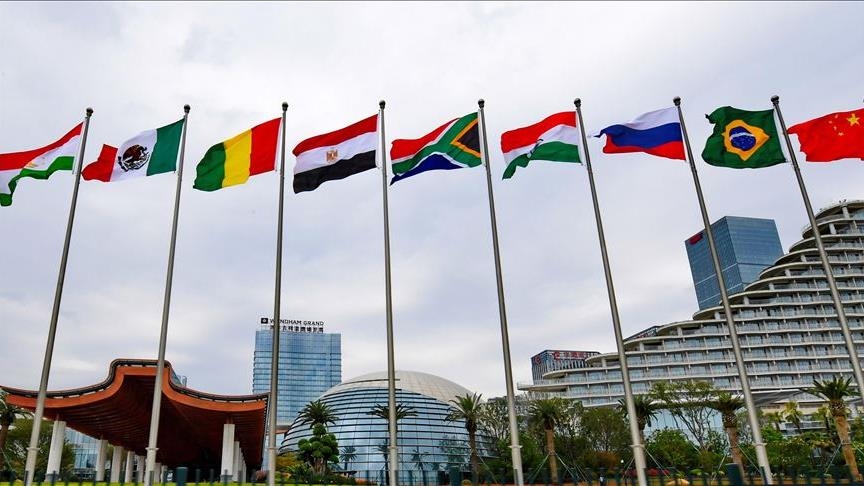
Fotoğraf: Anadolu Ajansı