
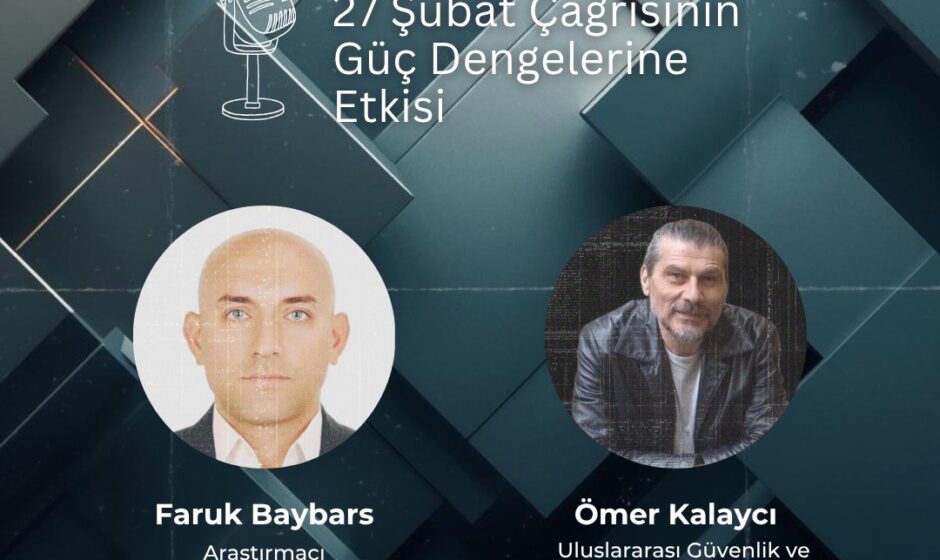

Faruk Baybars: In our previous interview, we touched upon significant issues regarding “The External Support Dimension of Terror and Terrorism.” Before starting our new interview, I would like to reiterate that we received a lot of positive feedback, which is important for understanding the significance given to the subject. The high interest, especially from our young friends working in terror and security fields, gives important signals for the future.
Dear professor, in this interview, I would like you to make a general evaluation of the current process affecting domestic and foreign politics simultaneously, through current dynamics, involving the organization [PKK], its political wing, and Turkish politics. My first question: In your opinion, is the PKK/KCK really an organization managed from a single center? When evaluated in the context of US-Israel supported regional power balances and internal chaos scenarios targeting Türkiye, what strategic purposes does the “laying down arms” rhetoric serve?
Ömer Kalaycı: They say, “The game is big,” and “State wisdom is at play.” Especially those who say, “This path was chosen to disrupt the US and Israel’s plan,” believe that conflicts in the region will end with the separatist Kurdish terrorist organization PKK/KCK supposedly laying down arms. However, they are in a great delusion. Because, thanks to the support of the US and coalition forces, which openly support the PYD/YPG in the region, and international public support, this structure has consolidated its position and evolved into a very different stage. Those who say, “They want to take this card out of the US’s hand and prevent Türkiye from falling into chaos,” should primarily look carefully at the number of illegal/irregular migrants entering the country. Therefore, the evidence put forward is not rational. Because the actors who want to destabilize the country and foreign secret services waiting on trigger already hold a huge card regarding illegal/migrants.
The separatist Kurdish terrorist organization PKK/KCK is not an organization managed from a single center. Regarding this, evaluating the separatist terrorist organization PKK/KCK as a monolithic terrorist organization in both written-visual media and social media platforms—which have become the center of perception—is a great delusion and looking at the subject askance. The PKK/KCK terrorist organization is a multi-component terrorist organization that has developed the ability to organize on many continents. In this context, it is also debatable whether there is coordination between “Qandil, Imrali, and DEM at the point of so-called political representation.” Because within the context of “Qandil, Imrali, and DEM,” there are also components of the US-Israel-UK and EU components like Germany-France. The terrorist attack on TUSAŞ, one of Türkiye’s most important defense industry establishments, after the call of MHP Chairman Mr. Devlet Bahçeli, should be read from this perspective.
PKK/KCK seeks to void Öcalan’s potential call to lay down arms or to extract larger concessions at the bargaining table by giving the message “we are still strong.” Indeed, the so-called leaders of the PKK/KCK terrorist organization have previously announced that the organization will not be liquidated and that no one, including Öcalan, can make the organization lay down arms.
Faruk Baybars: Well, professor, how do you evaluate the current stage of Türkiye’s struggle against the PKK terrorist organization, which everyone at the global level follows closely? In what aspects does the current process differ from the previous process?
Ömer Kalaycı: The PKK has not shown a change in its aims and objectives from its establishment in 1978 to the present; on the contrary, with the international political support it received, it has made significant progress in politicization. The organization, which repeatedly failed militarily against the Turkish Armed Forces, gained political power not only in Türkiye but also in neighboring countries during certain periods. At the point we have reached, the organization and its leader have declared ceasefires at various times. These are the ceasefires declared in 1993, 1995, 1998, 1999, 2006, 2009, and 2013. The last of these is the ceasefire declared on March 1, 2025, followed by the so-called disarmament ceremony.
Subsequently, when we read between the lines of the commission established and the topics discussed, it was said that “PKK would lay down arms, and there would be no bargaining in return.” However, at the point reached, the organization and its leader were accepted as the representative and interlocutor of all Kurds through the so-called Kurdish problem. Afterward, the Speaker of the Grand National Assembly of Türkiye (TBMM), who chaired the commission, made a statement saying, “If the National Security Council decides that the PKK is not a terrorist organization, legal regulations can be made.” As far as we know, the MGK takes advisory decisions. It is understood that along with legal regulations, there is a constitution! This shows that the nation-state structure of the Republic of Türkiye is in danger.
Faruk Baybars: So, professor, a process that started interestingly might evolve into something much more interesting in the future compared to what is appearing on the horizon. I would like to move on to my other question. Why was the negotiation process carried out with the organization interrupted in the past? Could similar obstacles emerge again today? What are your thoughts on this?
Ömer Kalaycı: Although there are many reasons for the interruption of the first solution process, which started as of 2006 and was reflected to the public from 2009, the headlines that stand out at the basic point are; the difference in actors in the processes carried out, the fact that the interests of the PKK/KCK components, especially regarding Syria, had not gained full clarity, the internal dynamics in Türkiye responding much more openly and harshly to the process, the fact that it was not accepted by the general Turkish nation, and the exclusion of the TBMM. Following all this, we paid heavy prices with the call for Serhildan (uprising) followed by trench operations. However, it seems sufficient lessons were not learned from the first one, as we have entered a period parallel to the decisions of the organization leader and especially the PKK/KCK 12th Congress.
Coming to your question of whether similar obstacles will emerge today; although the organization’s armed militants within the country have been shifted to the PKK/YPG structure in Syria and the PJAK in Iran, KCK Co-Chair Karayılan himself personally states that the cell city structures YDG-H established by himself, and YPS as of 2019, are active.
As can be understood from the recordings where Öcalan’s teleconference calls with the PKK leadership cadre were exposed, they state that “Lausanne is over” and that they will transform the Republic of Türkiye State. Furthermore, although there are many sentences regarding the demand for autonomy in the minutes of the commission established under the roof of the TBMM, the Moro Autonomous Region is mentioned many times.
As a result; when we look at examples, including the negotiation processes of organizations that dissolved themselves and laid down arms, differences that cannot be compared with the negotiation process carried out in Türkiye are seen. The negotiation process carried out in Türkiye, whatever its name may be, will never and by no means produce a healthy result. At the end of every negotiation process, the Republic of Türkiye State and the Turkish nation paid heavy prices, but the organization and its so-called political extension party added a new one to their political gains. Along with this, political Kurdish nationalism has found a base in Türkiye as never before.
Faruk Baybars: That was very clear and explanatory, professor. With your permission, I would like a response to another question. What do you think it means to give the right to speak to Abdullah Öcalan, the founder of the PKK/KCK terrorist organization, in the Grand National Assembly of Türkiye? Furthermore, how long might the attack preparation made by the organization against TUSAŞ have taken? In connection with this, could you interpret the situation of cell houses in Ankara in terms of intelligence weakness?
Ömer Kalaycı: We have received some answers to these questions; whether we will receive the others, time will tell. However, beyond all this, a serious perception operation is being conducted. Türkiye’s most critical projects are produced in the facility targeted by the terrorist attack, and invaluable engineers work there. The perpetrators accessing the facility, taking people hostage, and the attack moments falling onto social media quickly somehow, became a major propaganda work for the organization. PKK/KCK is evidently trying to give the message to the engineers working in this field that “you are not safe.”
Faruk Baybars: We once again wish God’s mercy on our citizens who lost their lives in the attack and patience to their relatives. Before moving on to my question, issues such as whether Öcalan’s February 27 call will turn into concrete steps, to what extent it will be adopted within the organization, and conflicts that may occur in the organizational structure and decision-making mechanisms continue to remain uncertain. In this case, what is the probability of the February 27 call meeting serious resistance among elements that do not look warmly at ideological change or believe in the symbolic power of armed struggle? In this context, what does Öcalan’s call signify? Does this call include other extensions of the PKK? How does the aftermath, the foreground, the inside, and the outside of this call form a picture in your opinion?
Ömer Kalaycı: The publication of the February 27 call by Öcalan, the leader of the separatist Kurdish terrorist organization PKK/KCK, has created a new ground for debate on how the PKK/KCK is positioned at the international level. From the beginning, the vast majority of studies, political strategies, and diplomacy carried out on PKK/KCK in Türkiye have been handled through the “Kurdish problem.” Essentially, in Türkiye, there is not a “Kurdish problem,” but an armed terror problem based on political Kurdish nationalism. Therefore, all studies carried out with the center of gravity on the “Kurdish problem” could not be effective and healthy in the fight against terrorism. One of Türkiye’s priorities in foreign policy has been to introduce the PKK as a terrorist organization on a global scale and to convince ally countries to accept this definition; as a result of this strategy, the US, EU, and many countries have defined the PKK as a terrorist organization. However, with the publication of the organization leader Öcalan’s call, the rhetoric that the PKK is not just a terrorist organization but also a political actor has been strengthened.
The expression “In practice, the laying down of arms and the self-dissolution of the PKK requires the recognition of democratic politics and the legal dimension,” which was not in the February 27 call text but was conveyed as a “note” by Sırrı Süreyya Önder, showed that the issue of disarmament and dissolution of the organization is not definite and binding. With the said note, a message was actually given regarding the new constitution drafting process; it was suggested that Türkiye should take legal and political steps, and the ball was passed to the government and the parliament, so to speak.
There is no clarity on how the weapons surrender process will be structured. PKK/KCK laying down arms is not merely an intra-organizational issue but has evolved into a strategic process that will reshape the power balances in the region. Conducting the weapons surrender process without international observation and guarantee mechanisms will bring risks such as the misuse of surrendered weapons or them remaining uncontrolled. Besides weapons, a clear framework regarding the fate of terrorists who carried out terror acts has not been drawn either. If a step is taken regarding the general amnesty, which has been frequently brought to the agenda recently, the thought that justice has not been served will take root in the memory of the society. Furthermore, besides a possible general amnesty declaration, the risk of the “disarmament” process remaining only as an official document or declaration strengthens the possibility that terror cells, in particular, may continue their existence.
It is also clear that the February 27 call of the organization leader, who was tried with capital punishment and later sentenced to life imprisonment, is not inclusive for PKK/KCK’s extensions in Iraq, Iran, and Syria. In this context, the statement of Ferhat Abdi Şahin, the administrator of the Syrian Democratic Forces (SDF)—which the US calls “my ground force”—and the PKK/KCK’s Syria extension PYD/YPG, saying “Öcalan’s call was directed at the PKK. It was not directly for our region,” and similarly DEM Party Co-Deputy Chairman Tayip Temel’s statement “The interlocutor of this call is the PKK. A call regarding the SDF is not in question,” can be interpreted as an effort to emphasize that there is no organic link with the PKK or to minimize this link. Most importantly, the PYD/YPG currently maintains its military/armed presence in Syria and is trying to obtain autonomy. It would be more meaningful to evaluate statements that do not completely reject the PKK-YPG relationship but try to separate it within this framework.
Türkiye conducts cross-border operations viewing the YPG as an extension of the PKK and evaluates the structure in northern Syria as a national security issue. It is possible to interpret the YPG/SDF’s attempt to separate itself from the PKK as an attempt to deter Türkiye’s possible operations or at least to show these operations as illegitimate in the international public opinion from now on.
While Israel’s attack on Iran and the decapitation targeting HAMAS continues, Iranian Kurdish groups called for starting a new struggle against the regime. Kurds living in Iran constitute the country’s third-largest ethnic group after Turks and Persians. The war between the two countries created a unique opportunity for separatist Kurds to voice their long-standing political demands more loudly. However, the situation on the ground is also quite complicated. Because separatist Kurds living in Iran state that they face significant restrictions regarding their culture, language, and political rights. The wave of protests against the government that started with the Kurdish slogan “Jin, Jiyan, Azadi,” meaning “Woman, Life, Freedom,” following the death of Iranian Kurdish woman Mahsa Jina Amini, who was detained by Iran’s morality police in September 2022 for allegedly wearing her headscarf inappropriately, is significant for understanding the dimension of the reaction against these restrictions.
Faruk Baybars: In light of these evaluations, meaning in the current table, which groups are active in the field? The Kurdistan Democratic Party of Iran (KDPI), Komala Party of Iranian Kurdistan, Kurdistan Freedom Party (PAK), and Kurdistan Free Life Party (PJAK) stand out as opposition groups. These parties also have bases in Iraq, but their activities are restricted by both the Iraqi central government and the Iraqi Kurdistan Regional Government.
Ömer Kalaycı: The border security agreement signed between Iran and Iraq in 2023 was the most important example of this restriction. The agreement included moving separatist Iranian Kurdish militants away from the border, disarming them, and placing them in camps far from the center. At the end of 2022, camps of Iranian Kurdish militants located in Iraq were bombed by the Iranian army. Although Iraqi officials say they placed these groups in regions approximately 100 km away from the Iranian borders as per the agreement provisions, it is understood that the goal regarding disarmament has not been reached.
Among these groups, the Kurdistan Democratic Party of Iran (KDPI) has an older history compared to the others. Established in 1945, the party bases its heritage directly on Mahabad. As you know, Mahabad is a city in Iran, but it is also the name of the so-called Kurdish state established with the support of the Soviet Union during the WWII era and destroyed by the Iranian monarchy in the same year after the Soviet Union withdrew. Making a statement in June of this year, the party said, “As long as this regime remains in power, the situation will get worse. Therefore, the first and most important prerequisite to save Iranian citizens from this crisis, destruction, and darkness is to completely eliminate and end this regime.” Komala Party Secretary General Abdullah Mohtadi called for “A free, democratic, secular, and federal Iran where the rights of Kurds and other ethnic groups are constitutionally protected and which is free of nuclear weapons.” Similarly, the Kurdistan Freedom Party reiterated the call for uprising by stating they support the process of destroying Iran’s military infrastructure and toppling the regime.
PJAK, the Iran branch of the separatist Kurdish terrorist organization PKK/KCK, evaluated the war between the two countries as an opportunity to move the “Jin, Jiyan, Azadi” movement to a new stage and emphasized that they are ready to take action against the Iranian regime. Undoubtedly, these statements are welcomed by many Iranian Kurds who want to see major changes in Iran, but debates on what to do next gain more weight. At this point, the biggest obstacle before said groups is the disarray at the leadership/cadre level and the limitation of military capacity. This situation prevents strategic coordination even if public support increases. Furthermore, this division both instrumentalizes these actors and makes them easily suppressible.
The Georgetown alliance is also an important example to understand the disorganized structure of the opposition in Iran. Established by dissidents in exile, including Komala Party Secretary General Abdullah Mohtadi, this alliance highlighted the demand for a “decentralized, democratic, secular political system” in their solidarity declaration. This alliance, consisting of eight people including the son of Iran’s last shah, Reza Pahlavi, took a blow with the departure of another dissident along with Pahlavi. KDPI leader Mustafa Hijri stated in an interview with the BBC that “The Kurdish people will not cooperate with the son of the former dictator, Reza Pahlavi, under any circumstances.” Therefore, it is possible to say that there are strategic differences rather than political goals among Iranian Kurdish groups. Also, a legitimacy conflict and representation crisis may arise between the internal opposition and external opposition.
PKK’s Iran extension, PJAK, differs from the others at this point. PJAK, which is supported more because it is a part of the PKK, seems likely to be affected by the main group’s dynamics, even though they emphasize that PKK’s dissolution declaration is not binding for them. From Iran’s perspective, PJAK was a structure that was directly pressured but positioned as “less of a threat” compared to other Kurdish groups in the past. However, after the Iran-Israel war, this stance is likely to change. Iran will most probably continue its classic reflex of oppression policy, but tactical openings might come to the agenda in situations where internal pressure shakes the regime. From Türkiye’s perspective, PJAK means the PKK diversifying its power in the region as its Iran branch. In this case, the PKK has transferred some of its forces to PJAK, shifting former militants who cannot or do not want to return to Türkiye, to Iran. Most importantly, depending on the course of the process carried out with the PKK, the organization may use PJAK as leverage or sacrifice it.
Faruk Baybars: The course of the process is pregnant with many events, professor. I believe some are making their preparations against all kinds of scenarios. I am moving to my last question. The US Ambassador to Ankara and Special Representative for Syria, Tom Barrack, while emphasizing that the equation on the ground is unsustainable without taking the Damascus administration as an interlocutor—stating that the federal administration model will not work in Syria—is simultaneously giving the message to YPG/SDF: “Do not seek international guarantees to transform your autonomy demand into a federative state.” How do you evaluate these statements and messages of Barrack?
Ömer Kalaycı: There are two main issues in Tom Barrack’s messages: The first is to manage centrifugal tendencies in a controlled manner and not to completely collapse the new administration in Syria; the second is Israel’s security. The separatist Kurdish terrorist organization PKK/KCK’s so-called organization dissolution and disarmament process cannot be evaluated independently of these conditions. The PKK/KCK terrorist organization entering a de facto dissolution process should be seen as a manifestation of regional developments beyond internal political debates. Ferhad Abdi Şahin (Cilo)’s representation in the West, the timing of Öcalan’s video message, YPG-Damascus administration talks, show how the new Kurdish political actors after PKK will be articulated into the international system.
In summary, the separatist Kurdish terrorist organization PKK/KCK is transferring its ideological heritage to Syria through the PYD/YPG. Although Tom Barrack’s other message “there will be no federalism” is rhetorically important, it is also possible to evaluate it as empty talk with no guarantee against the realities of the field and the power vacuum on the ground. Because Şahin Cilo’s statement “Old Syria was a centralized regime ruled by dictatorship. We want a decentralized Syria,” and finally Tariq el Shara supporting this statement should not be forgotten. The expression “Federal State” may be seen as a red line for countries supporting Syria’s integrity, but the Western-backed “strong local administration” model has a high probability of being accepted as legitimate by those shaping Syria.
Faruk Baybars: Dear professor, I thank you for answering my questions regarding the process in our country and the future, based on all material evidence together with the memory of the past. A terror-free Türkiye is our common goal. However, I think the implementation of methods that the vast majority of society will not accept in line with this goal is the biggest obstacle to the process reaching real success. I thank you very much for this interview.