

Mohammad Ali Ghanamizadeh Fallahi
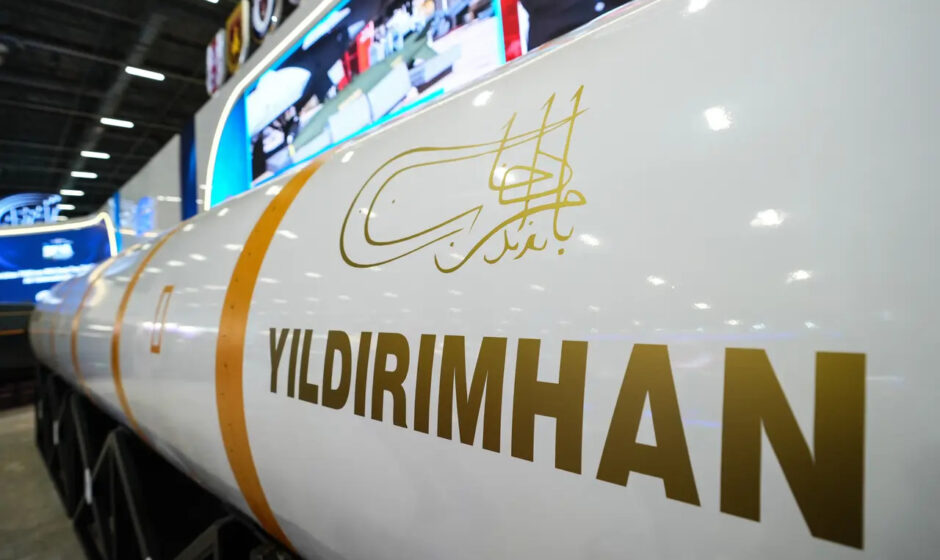
The spring of 2026 marks a pivotal juncture in the history of the Middle East. On February 28th, the United States and Israel initiated a wave of airstrikes against Iran under two operations, Epic Fury and Roaring Lion. On the opposite end of the region, Türkiye, in a highly calculated maneuver, unveiled two strategic weapons during the SAHA 2026 defense industry exhibition: the Yıldırımhan intercontinental ballistic missile and the Neşter kinetic bladed munition. This simultaneous unveiling broadcast a multilayered message to regional and extra-regional actors: Ankara is rapidly completing its transformation from a proxy power to an independent strategic actor. The central question is: How has the collapsing order of the Middle East redefined Türkiye’s weapons doctrine? The answer must be sought within the fabric of these two projects.
This timing was hardly coincidental. As the Iran war unleashed a cascade of destabilizing effects across the region—ranging from the closure of the Strait of Hormuz and the paralysis of global energy supply chains to the resurgence of proxy violence in Iraq, Syria, and Lebanon—Türkiye found itself at the epicenter of a geostrategic vacuum. The rapid erosion of American military primacy in the Gulf, the demonstrated vulnerability of Israeli territory to sustained missile barrages, and the spectacular failure of multilateral diplomacy to contain the crisis collectively underscored a singular reality: the post-Cold War security architecture, underwritten by NATO and anchored in the assumptions of U.S. hegemony, could no longer guarantee stability along Türkiye’s southern periphery. It was within this volatile context that Ankara chose to reveal its new arsenal, signaling not only the maturation of its indigenous defense industrial base but also the crystallization of a novel strategic doctrine. This doctrine, which the Turkish Ministry of National Defense would shortly thereafter codify as Fluid Deterrence, rests on the deliberate synergy between two radically different classes of armament—one designed to project catastrophic conventional power across continents, the other engineered to conduct silent, surgical elimination with minimal political blowback. Together, the Yıldırımhan and the Neşter represent far more than incremental technological advances; they are the material expression of a strategic culture in profound transformation, one that seeks to position Türkiye not as a compliant NATO flank state but as an autonomous pole of power capable of independently shaping the security environment from the Eastern Mediterranean to the Caucasus and beyond.
Anatomy of a Surprise: Yıldırımhan, Deterrence in the Intercontinental Class
The Yıldırımhan, whose name translates to Khan of Thunder, represents a quantum leap in Türkiye’s missile capability. Developed by the Turkish Ministry of National Defense’s Research and Development Department, this missile, with its declared 6,000 kilometers range, effectively enters the classification of an intercontinental ballistic missile (ICBM). The announced specifications indicate a design for hypersonic speeds (Mach 9 to 25) and the use of liquid fuel (asymmetrical dimethylhydrazine and dinitrogen tetroxide), a technology previously exclusive to the highly restricted club of global missile powers.
To comprehend the true dimensions of this achievement, one must view it through the lens of strategic perception.The missile’s 6,000 kilometers radius, when drawn on a map originating from Ankara, creates an imaginary circle that encompasses not only the entire Middle East but also European capitals, Moscow, Beijing, and deep into Russian territory. Unlike Türkiye’s space program, which has a peaceful nature, the Yıldırımhan is a definitively military, surface to surface system. Israeli military analysts have termed it the Apocalypse Monster,a label indicative of the level of concern in Tel Aviv. At this juncture, an innovative question arises: Has Ankara effectively added psychological deterrenceto its strategic arsenal by unveiling this missile? The evidence suggests it has, because the mere display of such a capability, even prior to any operational use, significantly amplifies Türkiye’s political leverage at every negotiating table.
A more nuanced issue is the matter of capability under a nuclear umbrella.In a context where other ICBM powers utilize nuclear warheads to punctuate their power, how effective can the Yıldırımhan’s 3 tons conventional warhead, likely a high-explosive or thermobaric type, be in the deterrence equation? Undoubtedly, this missile cannot replace a nuclear arsenal. However, for Türkiye, a NATO member operating under the alliance’s nuclear deterrence umbrella, achieving the status of a nuclear ICBM power may not be necessary. Instead, the missile’s high conventional destructive power transforms it into an instrument for delivering a crippling strategic blowagainst any threat far from its borders. This is a concept that can be termed conventional deterrence on a continental scale.
Neşter: Surgery in the Shadows
At a far remove from the fearsome grandeur of the Yıldırımhan, Türkiye’s other product at SAHA 2026, the Neşter, tells an entirely different story. This munition, developed by Roketsan and based on the widely used MAM-L family, is essentially a kinetic bladed missile.The Neşter lacks any conventional explosive material. Instead, prior to impact, it deploys six sharp steel blades from its body to literally slice the target apart using solely the kinetic energy of a supersonic speed exceeding Mach 1.4.
The Neşter’s function is reminiscent of the famous American AGM-114R9X Hellfire, nicknamed the Flying Ginsuin military circles. Both are explosion free and designed for the targeted, hyper-precise eliminationof high-value individuals. The key difference is that the Neşter, unlike the Hellfire, is not specifically for attack helicopters but is uniquely optimized for Türkiye’s indigenous drones: the Bayraktar TB2, TB3, Akıncı, Anka, and Aksungur. This means Istanbul now possesses an entirely domestic observe, detect, track, and surgically eliminatesystem, with the loop completed using fully indigenous products.
Imagine Target moving in civilian vehicles along crowded streets. A conventional drone strike with explosive munitions, akin to those conducted by the U.S. with the MQ-9 Reaper, carries heavy political and legal consequences: scores of civilian casualties, destruction of urban infrastructure, and a diplomatic crisis. The Neşter, with its cutting blades, can neutralize a single individual or vehicle on a crowded street without even scratching the walls of adjacent buildings. This capability reduces the political risk of targeted assassinationsto an absolute minimum and allows states to conduct sensitive operations with a defensible shield in international forums. With this achievement, Türkiye has effectively created a new, exportable targeting doctrinewith the potential to revolutionize the global gendarmerie in the realm of special operations in the shadows.
The 2026 Iran War: A Catalyst in the Midst of the Storm
In the tumultuous history of the Middle East, wars have always played the role of a defense innovation laboratory.The 2026 Iran War, which began on February 28th with American and Israeli airstrikes and saw the targeted killing of senior IRGC Quds Force commanders and top leaders of the Islamic Republic’s military apparatus, is no exception. Although the war has not yet reached a decisive conclusion, it has provided profound strategic lessons for Türkiye.
The first is the lesson of deterrence. The continuation of Iranian missile strikes deep into U.S. bases in the region, from Al Asad in Iraq to Al Dhafra in the United Arab Emirates, demonstrated that a regional actor with a diverse ballistic missile arsenal can inflict logistical and reputational attrition on even a superpower like the United States. Türkiye received the message that conventional deterrenceis not a luxury commodity but an existential imperative.
The second is the lesson of multi-layered air defense systems. Despite crippling sanctions, Iran deployed its Bavar-373 and Third of Khordad systems, successfully downing advanced American and Israeli drones. This highlighted the critical importance of self-sufficiency in surface to air missile systems,the very path Türkiye has been pursuing for years with the development of the Hisar and Siper families.
The third is the lesson of shadow operations. The 2026 Iran War also demonstrated how the United States and Israel used targeted assassinations against Iran’s field commanders and nuclear officials in parallel with highly publicized bombing campaigns. Precision strikes by unmanned aerial vehicles were at the forefront of these operations. This is where the Neşter emerges as an intelligent complement to Türkiye’s drone doctrine. If Turkish drones previously functioned only as an intelligent eye and sword,they are now armed with a smart scalpel.
The fourth is the lesson of chokepoint obstruction and energy security. The disruption of tanker traffic in the Strait of Hormuz by Iran pushed Europe and parts of Asia to the brink of economic collapse. This crisis redoubled the importance of Türkiye’s coastline and waters in the Eastern Mediterranean and the critical straits under Ankara’s supervision. In this context, the Yıldırımhan is not merely a surface to surface missile; it is also an instrument for defending vital energy corridors against any long-range threat.
The Power Puzzle: The Synergy of Hard and Soft Hardware
A subtle point often overlooked by Western analysts is the combination of these two contrasting weapons on a single operational platform: drones. The Bayraktar Akıncı, the giant of Türkiye’s drone fleet, currently has the capacity to launch MAM-L munitions, and naturally its kinetic variant, the Neşter, while simultaneously serving as a launch platform for air launched cruise missiles like the SOM-J and Çakır. While the Yıldırımhan’s massive dimensions and weight currently preclude its launch from an aircraft, a question arises: Is Türkiye developing an air launched variant of this missile for the Akıncı or even the Kızılelma unmanned fighter jet? The modular design philosophy of the Turkish defense industry strengthens this hypothesis.
In Türkiye’s 2026 Defense Doctrine Reform Document,the public version of which was released three days after the SAHA exhibition, a new concept termed Fluid Deterrence (Akışkan Caydırıcılık) was introduced. According to this concept, Türkiye will no longer rely solely on the traditional doctrine of preemptive defense.Instead, by combining a strategic strike capability with continental range (Yıldırımhan) with tactical surgical lasers (Neşter), it will provide a full spectrum of coercive responses proportionate to any threat, ranging from proxy insurgencies to the threat from a nuclear power.
The Geopolitics of a Dual Unveiling: A Message to the Actors in the Crisis
The transmission of compressed, multifaceted messages was arguably the primary objective of this unveiling amidst the regional maelstrom. For the United States, Ankara’s message is clear: You need us in Syria, Iraq, and the Eastern Mediterranean. However, should you withdraw NATO’s protective umbrella, we possess an independent deterrence option against Iran or Russia.For Moscow, this unveiling signifies that our cooperation in Syria and the Caucasus is conditional; Türkiye can, if threatened, target your strategic depth.
Yet, the most compelling dynamic is unfolding within the Ankara-Tehran-Tel Aviv triangle. On one hand, Israel, which viewed itself as the sole technological military power in the region,now observes Türkiye catching up and even overtaking it in certain domains. The unveiling of the Yıldırımhan, in particular, is a terrible alarm bell for Israel, as until now, any serious missile threat against Tel Aviv was conceived only from Iran. A Sunni NATO actor has now joined this club. On the other hand, Iran, under sanctions and the barrage of attacks, observing Türkiye’s growing arsenal, will see no path but to deepen its own missile program, particularly in the domain of solid fuel hypersonic technology. This arms-security cycle is precisely the expanding dangerous vortexthat analysts fear.
Final Word: Ankara, Capital of Two Swords
The 2026 Iran War once more confronted the world with the bitter truth that the post-Cold War international order is more fractured than imagined. In this Hobbesian space, Recep Tayyip Erdoğan’s Türkiye views strategic autonomynot as a political slogan, but an existential necessity. The simultaneous unveiling of the Yıldırımhan, the iron shield of Anatolia, and the Neşter, its venomous dagger, amidst the flames of a war spreading from the Persian Gulf to the Mediterranean, carries a historic message. Modern Türkiye is no longer merely a bridge or intermediary between East and West. The nation has now itself evolved into an independent pole of power in the security equations of the Islamic world and, indeed, the whole of Eurasia. It is a power that can, with one hand, bring thunderfrom the sky upon any continental threat and, with the other, perform a silent and lethal surgeryin the darkest alleys of shadow wars. The final question is this: Is the world, particularly the West, prepared to accept this new reality?