

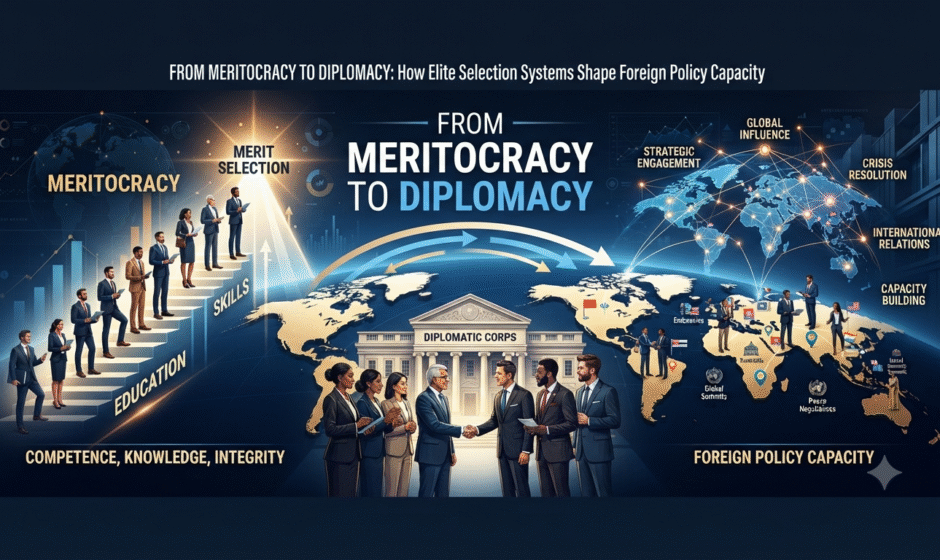

A country’s consistency in foreign policy is usually attributed to strategic documents, doctrines, or the personal vision of its leaders. Yet one layer tends to go unnoticed: how the human capital that interprets that strategy day to day, sits at the negotiating table, and makes decisions in a crisis is actually selected. Viewed through the lens of industrial and organizational psychology, states are themselves large-scale organizations, and organizational performance is bounded, to a significant degree, by the quality of its recruitment, competency-development, and promotion architecture. A well-crafted foreign policy doctrine remains a dead letter if the personnel tasked with executing it are not up to the job; conversely, even a mediocre strategy can be partly redeemed by a strong diplomatic corps. This piece reads three distinct selection philosophies-China’s cadre system, Singapore’s scholarship-based talent management, and Türkiye’s career diplomatic model-through the concepts of organizational psychology, and examines what each implies for foreign policy capacity.
China’s Cadre System: Institutionalized, Long-Horizon Selection
The Chinese Communist Party’s “cadre system” (ganbu zhidu) draws on the Soviet nomenklatura legacy, but its roots run much deeper, back to the imperial civil service examinations and the Confucian tradition of merit. What sets the system apart is that promotion is tied not to a single exam but to a performance-tracking process spread across decades: a cadre who has not proven themselves at the local level stands almost no chance of taking on responsibility at the center. Having served at the provincial level is nearly a mandatory rung on the ladder to the central bureaucracy, and the passage between these rungs runs through periodic evaluation by senior party commissions.
This aligns with what organizational psychology calls “progressive competency building”: leadership potential is confirmed not by a single snapshot assessment but through repeated observation across different contexts. How a manager performs running a small unit is treated as a reliable predictor of whether they can take on a larger, more complex responsibility-a logic sometimes referred to in the personnel psychology literature as an “escalating responsibility test.” Term limits and the principle of collective leadership, meanwhile, act as a structural brake against the risks of power accumulation well documented in the organizational behavior literature-the tendency of charismatic leadership to curdle into something more corrosive, or the fragility of decision-making structures overly dependent on a single individual. In this sense, the Chinese model turns selection from a one-time gate into a continuously operating filter.
The Singapore Model: Talent-Hunting and Market-Style Competition
Standing in contrast to China’s gradual, inward-facing model is Singapore’s much earlier and more outward-facing approach to selection. Singapore’s Public Service Commission identifies future senior bureaucrats and diplomats while they are still university-aged, awarding them scholarships; these candidates are educated at leading universities both at home and abroad and are bonded to serve in the public sector for a set period after graduation. The most striking feature of the system is that public-sector salaries are kept close to equivalent private-sector positions-a deliberate compensation policy designed to prevent talented candidates from being lured away.
From the standpoint of human resources psychology, this is the state-scale application of a “talent attraction and retention” strategy. Singapore’s approach selects at the very start of a career, on the basis of potential; China’s approach re-selects throughout a career, on the basis of demonstrated performance. Each carries its own risk: betting early on potential (Singapore) is exposed to misjudgment, while relying solely on accumulated performance (China) requires years of waiting before someone reaches the top-a real cost of agility in a foreign policy environment that changes quickly.
Türkiye’s Career Diplomacy: From Point-in-Time Assessment to Process-Based Assessment
Türkiye’s Ministry of Foreign Affairs Candidate Career Officer examination bears the marks of a similar effort: a written exam is supplemented with a reasoning/analysis aptitude test and an oral interview, in an attempt to move beyond the measurement of knowledge alone. In the oral stage, a candidate’s representational ability, behavioral consistency, and overall suitability for the profession are scored separately-a simplified version of what personnel-selection psychology calls the assessment-center approach. The fact that a career officer can lose their standing through repeated failure on the proficiency exam later in their career shows that selection continues well past the point of entry.
There is, however, a notable point of divergence from both the Chinese and Singaporean models: the Turkish system weighs individual exam and interview performance most heavily, whereas the Chinese model interweaves multi-stage field performance with peer and superior evaluation, and the Singaporean model combines early investment in potential with competitive compensation. The organizational psychology literature shows that exam and interview performance has limited power to predict actual job performance, whereas structured interviews and work-sample tests combined with general mental ability measures are considerably stronger predictors; the classic meta-analysis by Schmidt and Hunter, synthesizing 85 years of research findings, found that such combinations carry substantially higher validity than a general ability test on its own. Along these lines, supplementing the entry-level merit filter in career-diplomacy models with systematic, multi-source assessment mechanisms at mid-career stands out as a general principle frequently advanced in the comparative public-administration literature.
Beyond Selection: Socialization and Institutional Memory
Cultivating an elite corps is not just about who gets selected-it is also about how those selected internalize the institution’s tacit knowledge: its unwritten protocols, historical sensitivities, and negotiating reflexes. Organizational socialization theory holds that this transfer is reinforced through mentorship, gradually expanding responsibility, and crisis simulation. China’s career ladder, stretching from local government up to the center, makes this almost obligatory; Singapore’s post-scholarship rotations achieve something similar by moving young talent through different ministries. In more centralized, fast-track promotion structures, by contrast, the transmission of this kind of tacit knowledge can weaken; an official newly arrived in a role who does not understand why the institution took a particular stance during a past crisis may be more likely to repeat the same mistake. A foreign ministry’s ability to respond with a consistent reflex in moments of crisis-a sudden regional conflict, say-depends heavily on how solidly this quiet transmission has been built.
Conclusion: Human Capital as Foreign Policy’s Invisible Infrastructure
Foreign policy analysis is typically conducted through the lens of balances of power, alliances, and doctrine; the architecture of human capital tends to stay in the background. Yet the limits of a country’s diplomatic skill are drawn largely by how it selects and develops its elites. The comparison of the three models shows there is no single “correct” form of selection-each approach carries its own trade-off: China builds depth and consistency at some cost to agility; Singapore secures agility and competitiveness at the risk of early misjudgment. The general principle to draw from the comparison is this: supporting an entry-level, merit-based filter with a sustainable competency-development system across a career-regular multi-source (360-degree) evaluation, inter-agency field rotation, and crisis simulation-stands out as a choice that strengthens foreign policy capacity. Meritocracy is a principle that needs to operate not just at the door, but in the corridor beyond it.
References
Burns, J. P. (1989). The Chinese Communist Party’s Nomenklatura System. M.E. Sharpe.
Manion, M. (1993). Retirement of Revolutionaries in China: Public Policies, Social Norms, Private Interests. Princeton University Press.
Schmidt, F. L., & Hunter, J. E. (1998). The validity and utility of selection methods in personnel psychology: Practical and theoretical implications of 85 years of research findings. Psychological Bulletin, 124(2), 262-274. https://doi.org/10.1037/0033-2909.124.2.262
Sezen, S. (2021). On China’s Political and Administrative System [Interview]. DAAD Journal, Fall 2021.
Çamurcuoğlu, G. Meritocracy. Dergipark.
Republic of Turkey Ministry of Foreign Affairs. Diplomatic Career and Career Officer Track. https://kariyer.mfa.gov.tr/kariyer/Diplomatik-Kariyer.html
Republic of Turkey Ministry of Foreign Affairs. (2025). Candidate Career Officer Entrance Examination Announcement. https://kariyer.mfa.gov.tr
Singapore Public Service Commission. Scholarships and Talent Development Framework. https://www.psc.gov.sg