

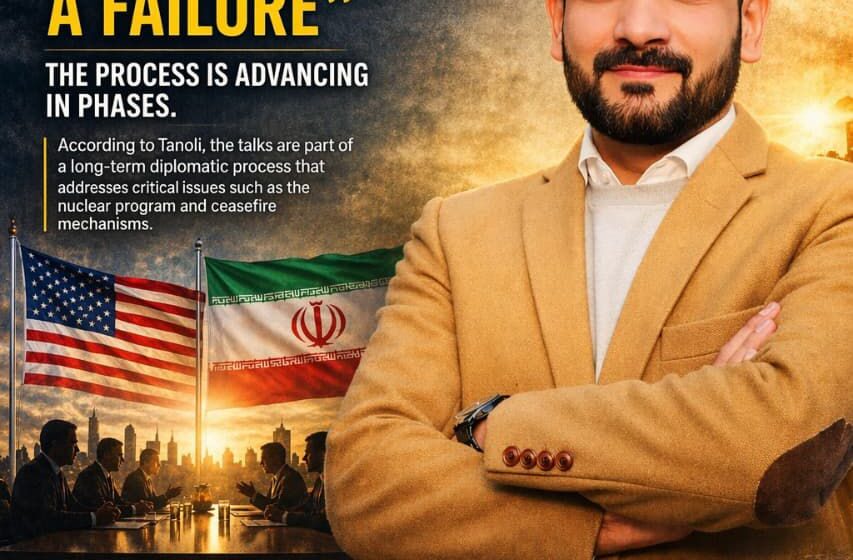

The recent diplomatic engagement in Islamabad between the United States and Iran has triggered predictable reactions across geopolitical circles. Many have rushed to label the talks a failure, pointing to the absence of a formal agreement as evidence. This interpretation is not only premature, it reflects a fundamental misunderstanding of how high stakes diplomacy actually functions.
Diplomacy between adversarial states is rarely designed to deliver instant, tangible outcomes. It is a gradual process shaped by cautious engagement, calibrated messaging, and incremental progress. In this context, the Islamabad talks achieved something far more important than a headline agreement. They sustained dialogue at a moment when escalation remained a real possibility. The fact that both Washington and Tehran chose to engage, despite deep rooted mistrust, is itself a meaningful outcome.
From Pakistan’s perspective, the significance of these talks extends beyond the immediate interaction between the two parties. By hosting and facilitating this engagement, Islamabad positioned itself as a credible and neutral platform for dialogue. In an increasingly polarized international system, the ability to bring opposing sides to the table is not a minor achievement. It reflects a level of diplomatic trust that cannot be manufactured overnight. Pakistan did not merely host a meeting. It created space for communication at a time when silence could have easily led to confrontation.
The substance of the discussions further reinforces this point. Issues such as nuclear policy, ceasefire mechanisms, and regional stability are inherently complex. They cannot be resolved within a single round of talks. History offers a clear precedent in the form of the Joint Comprehensive Plan of Action, which emerged only after years of sustained negotiations. Even then, its eventual unraveling demonstrated how fragile such agreements can be in the face of shifting political dynamics. Expecting a comprehensive resolution in Islamabad was never realistic.
What the talks did achieve, however, is arguably more consequential in the short term. They contributed to a visible de escalation of tensions. There is no evidence of imminent large scale conflict, no indication of active military confrontation, and no breakdown in communication channels. Statements from key figures suggest that diplomatic options remain very much on the table. In a region often defined by volatility, the absence of war is not a trivial outcome. It is a strategic success.
Looking ahead, the next few weeks are likely to be critical. Rather than a dramatic breakthrough or collapse, what we can expect is continuity. Additional rounds of negotiations, possibly in different venues, will allow both sides to reassess their positions and refine their strategies. This is how diplomacy evolves. Each engagement, regardless of immediate outcomes, contributes to shaping the broader trajectory of relations.
To frame the Islamabad talks as a failure is to impose a binary lens on a fundamentally complex process. These talks were never about instant resolution. They were about maintaining momentum, preventing escalation, and keeping diplomatic pathways open. On all three counts, they delivered.
For Pakistan, the outcome carries particular significance. At a time when global politics is increasingly fragmented, Islamabad has demonstrated its capacity to act as a facilitator of dialogue. This is not just a symbolic role. It is a strategic one that enhances Pakistan’s diplomatic standing and reinforces its relevance in regional and international affairs.
The current moment calls for measured analysis rather than premature judgment. The Islamabad talks represent a fragile pause, not a definitive conclusion. The guns are silent, communication continues, and the possibility of progress remains intact. In the realm of diplomacy, that is often how meaningful change begins.